
Smart Outreach
Automate customer communication through AI-powered voice calls, emails, and WhatsApp messages.

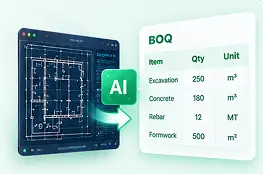
StrategicERP BOQ AI helps construction and infrastructure teams convert architectural and structural drawings into structured quantity sheets. It supports faster quantity takeoffs, consistent measurement workflows and clearer cost planning, reducing dependence on repetitive manual calculations. When connected to relevant rate and vendor data, teams can use the quantities as a foundation for estimates, procurement planning and budget reviews.
Precision AI tools engineered for enterprise performance.
Convert supported 2D and 3D drawing information into organized measurement sheets and quantity schedules.
Compile measured items into a standardized Bill of Quantities with item descriptions, units and quantities.
Link quantities with configured rate-analysis data or vendor catalogs to support estimate preparation.
Review drawing changes and identify quantities that may need recalculation when project designs are revised.
Use BOQ outputs to support material planning, requisitions and coordination between estimation and procurement teams.
A structured path from upload to approval.
Provide supported architectural or structural drawing files and relevant project specifications.
AI-assisted processing identifies measurable items and organizes quantities into structured schedules for review.
Review quantities, apply applicable rates and use the approved BOQ for estimation and procurement planning.
Spend less time compiling quantities manually and more time reviewing estimates.
Use structured measurement sheets and repeatable quantity workflows across projects.
Connect quantities with rate analysis to make estimate preparation and budget reviews more transparent.
Give estimation, engineering and procurement teams a common quantity reference.
BOQ AI software helps teams prepare a Bill of Quantities by organizing drawing-based measurements, material quantities and item schedules into a structured format.
Yes. BOQ quantities can be used with applicable rates and vendor data to support cost estimates. Final estimates should be reviewed against project specifications and current pricing.
No. It can reduce repetitive measurement and compilation work, while estimators remain responsible for checking assumptions, validating quantities and approving the final BOQ.
It helps teams identify quantity schedules affected by drawing changes so they can review and update estimates before procurement or execution.

StrategicERP from ITAakash Strategic Software (P) Ltd is a software platform for start-to-end process automation and information management systems customized for the Real Estate, Construction & Infrastructure industries. The product owes to its cutting-edge core technology development team, from IIT.
ITAakash Strategic Soft. (P) LTD, 5th floor, D S Business Galleria, Near Huma Adlabs, Beside Toyo House, L.B.S. Road, Kanjur Marg (W), Mumbai, 400078 INDIA.